Research
Published:
4 Feb, 2026
AI docs readership increased over 500% in 2025. What does it mean for you?
AI summary
AI readership of documentation sites grew dramatically in 2025, now accounting for over 40% of total traffic. While human readers remain the primary audience, documentation teams should focus on clear, structured content that serves both human comprehension and seamless AI ingestion.
At the start of 2025, AI systems made up less than 10% of readers for documentation published using GitBook. By the end of the year, they accounted for over 40%.
We analyzed data across all docs sites published using GitBook over the last 12 months, splitting page view data between human readers and AI tools.
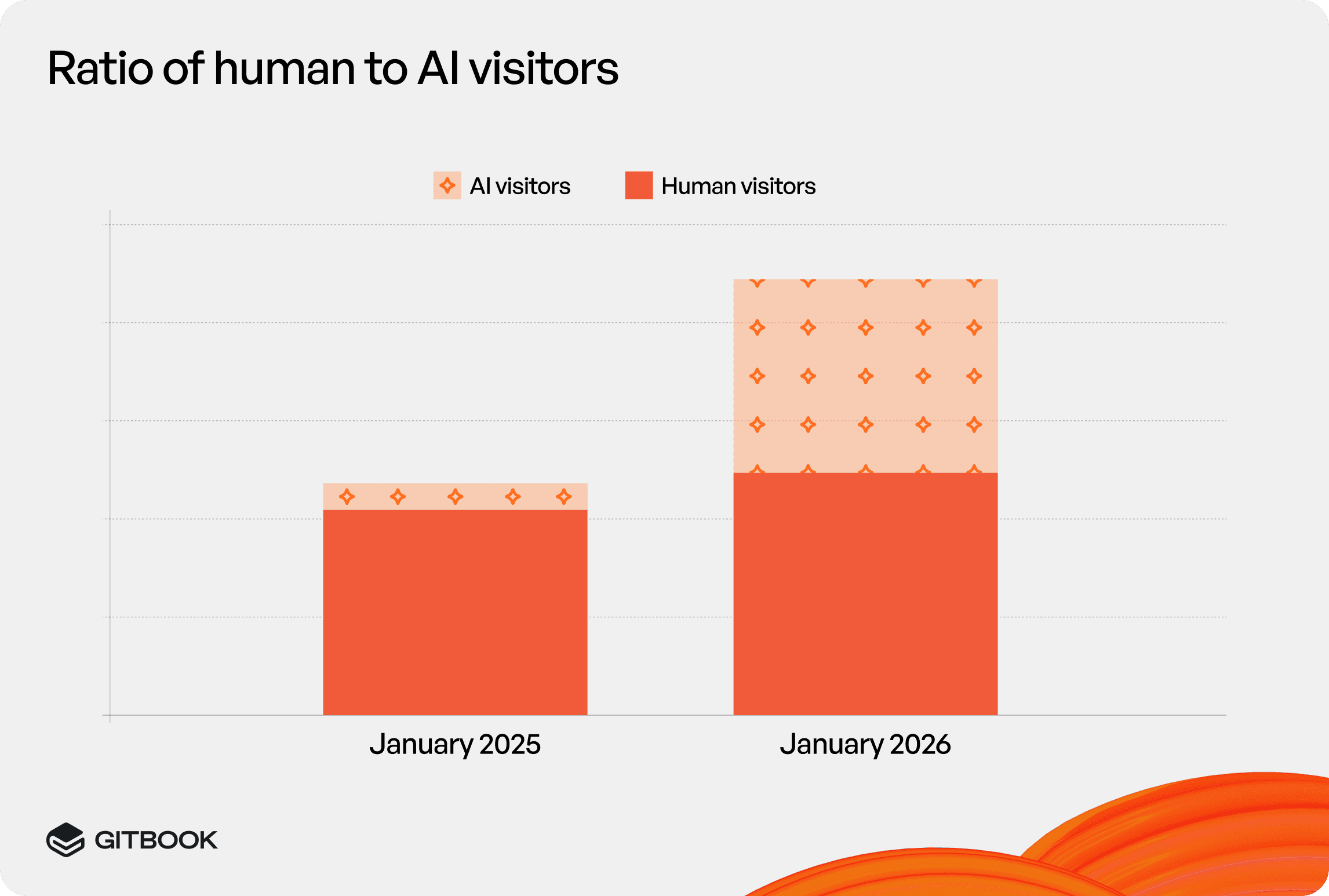
Looking at the actual number of AI readers visiting documentation sites, December shows over 500% or 5x more AI page views compared to January — a huge, fundamental shift in how documentation is consumed. Docs are no longer read only by humans. Increasingly, they’re read for humans, by AI systems acting as intermediaries.
This post looks at what the data shows, and what this change means for people who create and maintain documentation.
AI now accounts for 41% of all docs readers
Across 2025, we analyzed readership trends for documentation published on the GitBook platform. In January, AI readers represented roughly 9% of total traffic. That share grew steadily through the first half of the year, accelerated in late summer, and ended the year around 41–42%.
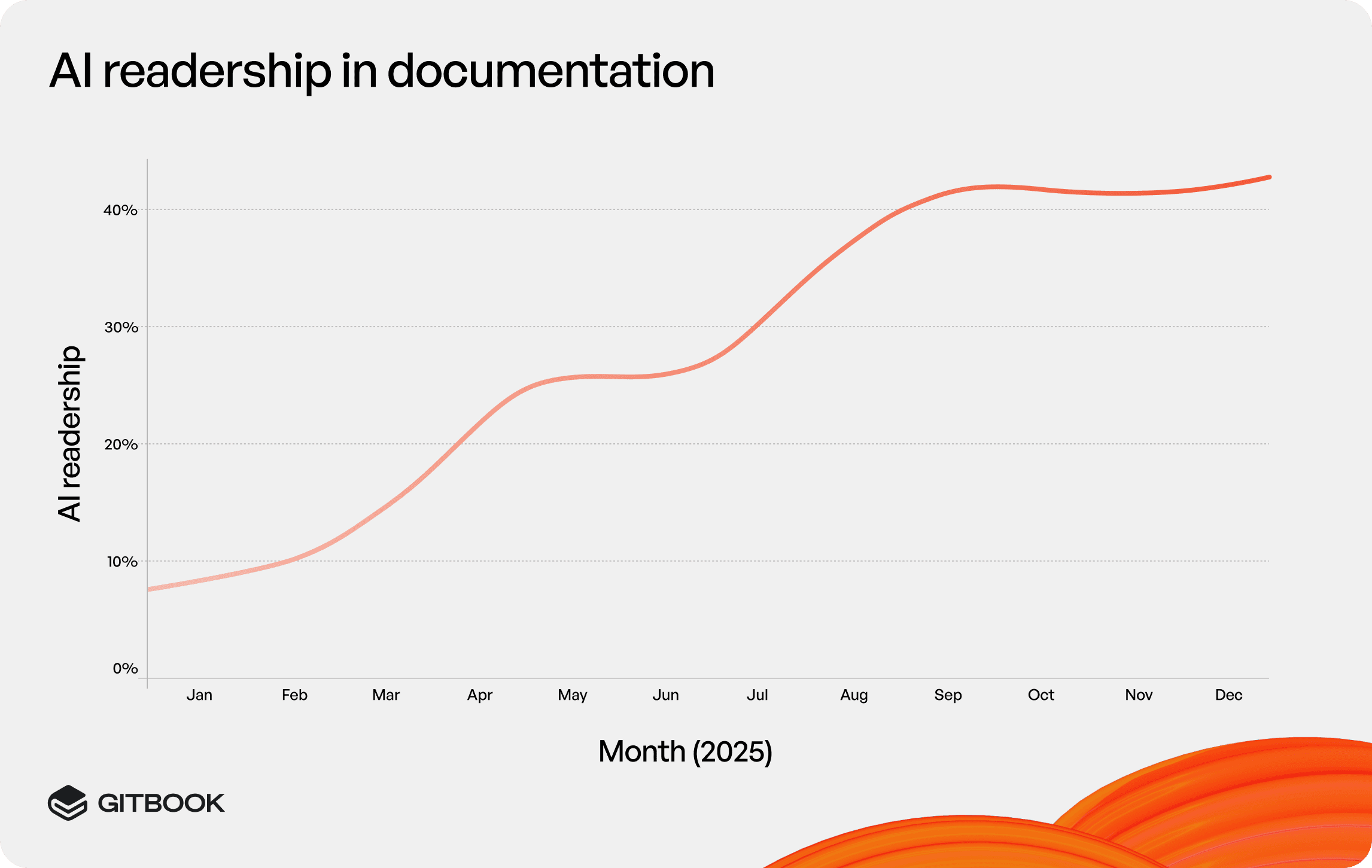
In other words, by December AI systems were responsible for roughly two out of every five reads of GitBook-hosted documentation.
This isn’t a short-lived spike or an anomaly. The sustained rise throughout the year suggests a new normal, not a passing trend.
This shift didn’t start in 2025 — but 2025 changed everything
And when we compare the data year-on-year the scale of the changes becomes even clearer.
At the start of 2025, AI made up less than 10% of documentation readers — but it’s activity was limited. AI systems existed at the margins — sampling and occasionally ingesting documentation, but not yet operating at scale.
At the start of 2026, that balance has shifted dramatically. Human readership remains strong — still accounting for 60% of total views — but AI readership more than quadrupled year over year, moving from an edge case to a core audience.
For documentation teams, that makes this moment different from past trends. It means that this isn’t something you need to start planning for eventually — It’s something to design for now.
For teams seeing the same shift in their own analytics, our agent-readiness checker helps turn the question from “are AI readers arriving?” into “can they successfully use what they find?” It’ll even highlight areas for improvement, to help you make your docs more AI-friendly.
Human readers are still dominant
It’s essential to remember that humans still represent the majority of documentation readers — for now, that hasn’t changed.
What has changed is the balance. Documentation now serves two large audiences at once: people reading directly, and AI systems reading on their behalf.
The important takeaway? This isn’t a zero-sum game where one audience replaces the other. Instead, AI increasingly shapes how humans discover, access, and use documentation.
That distinction matters. When an AI assistant answers a question using your docs, your documentation is still doing the work — just through a different interface.
What does this data mean for documentation creators?
The most obvious conclusion is that documentation needs to be readable by machines as well as humans.
But don’t start stuffing keywords into pages or writing for bots at the expense of clarity. In reality, the qualities that make docs easier for AI to ingest are largely the same ones that make them better for people.
Clear structure, consistent terminology, explicit context, and well-defined relationships between concepts all help AI systems understand and reuse your content. They also help human readers find answers faster and with less friction.
And don’t misunderstand this data. It’s certainly not a signal to abandon human-first documentation practices. Humans still read docs directly, and they care deeply about narrative flow, examples, and usability. Over-optimizing for AI while neglecting the human experience is a false economy.
The real shift is that documentation now needs to work well in two modes at once. But you don’t have to choose one or the other. Especially if your documentation platform is helping you optimize for them both.
GitBook is built for AI ingestion — without compromising humans
In 2025, we introduced a ton of GitBook features designed to make documentation easier for AI systems to consume, while preserving a great reading experience for humans:
Native support for llms.txt and llms-full.txt, giving AI systems a clear, standardized entry point to your docs
Markdown access for every page enabling clean, predictable ingestion (simply add
.mdto the URL)Automatic MCP server generation for every docs site, allowing AI agents to interact with documentation programmatically
It’s worth noting that these improvements likely contributed to the rise in AI readership we’ve observed. But the broader trend is unmistakable: AI systems increasingly rely on high-quality documentation as a source of truth.
As that continues, teams need documentation platforms that treat AI ingestion as a first-class concern — not an afterthought — while still prioritizing humans.
If you want your documentation to be useful in a world where AI accounts for nearly half of your readers, you need tools built for that reality. GitBook is designed to help you do exactly that.
→ Get started with GitBook for free
Share


Get the GitBook newsletter
Get the latest product news, useful resources and more in your inbox. 130k+ people read it every month.


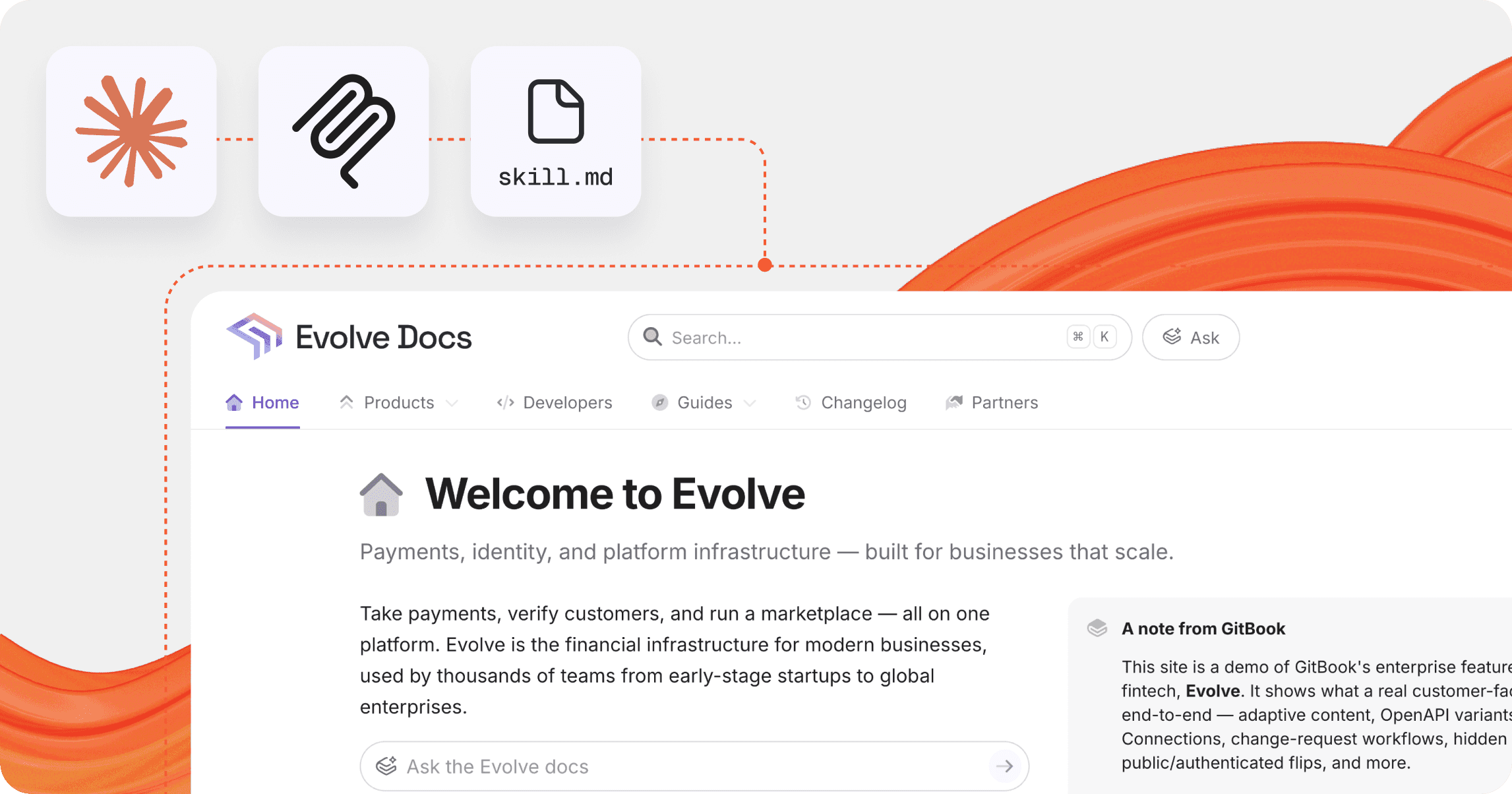


Accurate docs. Better answers.
Your docs are already feeding AI. Are users getting the right answers or the wrong ones?
Accurate docs. Better answers.
Your docs are already feeding AI. Are users getting the right answers or the wrong ones?
Accurate docs. Better answers.
Your docs are already feeding AI. Are users getting the right answers or the wrong ones?
Product
Create & Publish
Solutions
Resources

© 2026 Copyright GitBook INC.
440 N Barranca Ave #7171, Covina, CA 91723, USA. EIN: 320502699
Get an AI summary




The State of Docs Report 2026
State of Docs brings together insights from documentation experts from across the industry
Product
Create & Publish
Solutions
Resources
© 2026 Copyright GitBook INC.
440 N Barranca Ave #7171, Covina, CA 91723, USA. EIN: 320502699
Get an AI summary
The State of Docs Report 2026
State of Docs brings together insights from documentation experts from across the industry

Product
Create & Publish
Solutions
Resources
© 2026 Copyright GitBook INC.
440 N Barranca Ave #7171, Covina, CA 91723, USA. EIN: 320502699
Get an AI summary
The State of Docs Report 2026
State of Docs brings together insights from documentation experts from across the industry