Research
Published:
13 May, 2026
Research: AI agents are now the majority reader of your docs
AI summary
AI agents now account for over 50% of intentional documentation reads, marking a fundamental shift in how technical information is consumed. As these systems increasingly rely on documentation as an foundational knowledge layer, teams must prioritize clear structure and consistency to serve both AI and human audiences effectively.
In February, we published data showing that, during 2025, AI systems had grown from less than 10% of GitBook documentation readers to over 40% by year’s end. At the time, we called it a fundamental shift in how documentation is consumed.
Three months later, we have a new data point — and the line has moved again.
We analyzed one week (April 27–May 3, 2026) of traffic data across GitBook-hosted documentation sites with meaningful human traffic (more than 100 page views in April). When we look at purposeful reads — humans actively reading docs, and AI agents actively pulling them — AI has crossed 50% for the first time.
AI agents now account for 51.8% of intentional documentation reads on GitBook.
The trend is continuing, but where will it stop?
The numbers
Across 61.2 million total page views during the measurement week, here’s how the traffic broke down:
Category | Total requests | % of total |
|---|---|---|
Humans | 22,160,380 | 36.2% |
AI agents | 23,792,948 | 38.9% |
Bot crawlers | 14,769,932 | 24.1% |
Bot detected | 471,575 | 0.8% |
Total | 61,194,835 | 100% |
That puts total non-human traffic at 63.8% of all page views, but some of that traffic is from traditional crawlers from search engines like Google and Bing. More on that in a moment.
The most meaningful comparison is the human-to-agent split; when you isolate intentional reads and exclude crawlers, AI agents hold a narrow but clear majority: 51.8% to 48.2%.
It’s worth noting that approximately 22% (5.2M) of the agent traffic arrives with no identifiable bot name — tools that don’t declare themselves in their user-agent headers. That makes the split of specific tools hard to track. Still, we’ve done what we can with the data we have below.
If AI agents are already a majority reader, the next question is quality of access. GitBook’s agent-readiness checker shows whether those agents can find and use your docs reliably, not just request them.
Not all crawlers are created equal
Zooming back out to the full picture, the 24.1% crawler share deserves a closer look — because “crawler” doesn’t mean what it used to.
Traditional search engine crawlers are still present: Googlebot, Bingbot, DuckDuckBot etc. But they’re now just a small fraction of crawler traffic. The larger players tell a different story:
ByteSpider (ByteDance) — 15.7% of all crawler traffic
AmazonBot — 12.5% of all crawler traffic
AppleBot — 3.7% of all crawler traffic
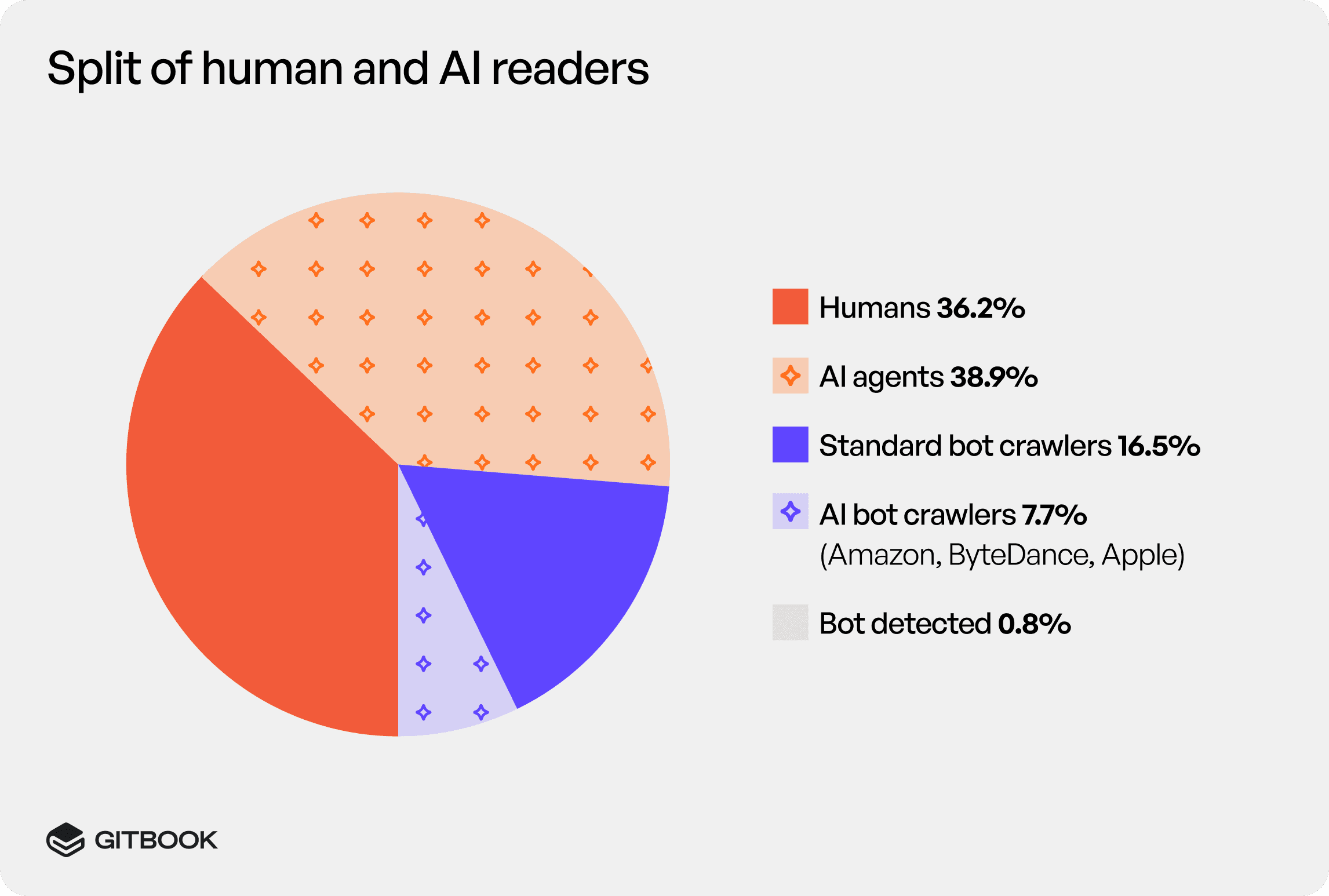
These aren’t crawlers building a traditional search index. ByteSpider feeds ByteDance’s AI products (the company is best known as the owner of TikTok). AmazonBot is used to train and improve Amazon’s AI systems, including Alexa. And AppleBot increasingly powers Apple Intelligence and Siri, which will reportedly get a major AI upgrade this fall. Together, they represent about 31% of all crawler activity on GitBook docs.
This means there’s a second, less visible layer of AI ingestion happening beneath the agent traffic — crawlers that are indexing and training on your documentation rather than retrieving it in real time. The 63.8% non-human number starts to look less like noise and more like a signal.
Who are the AI agents?
The agent breakdown is where the data gets particularly interesting — and somewhat surprising.
ChatGPT accounts for 54% of all agent traffic. It’s by far the dominant agent reading GitBook-hosted documentation, generating over 12.8 million page views in a single week. Meta AI comes in second at 12.4% of agent traffic — more than Cursor, Claude Code, Claude, OpenAI, and Perplexity combined.
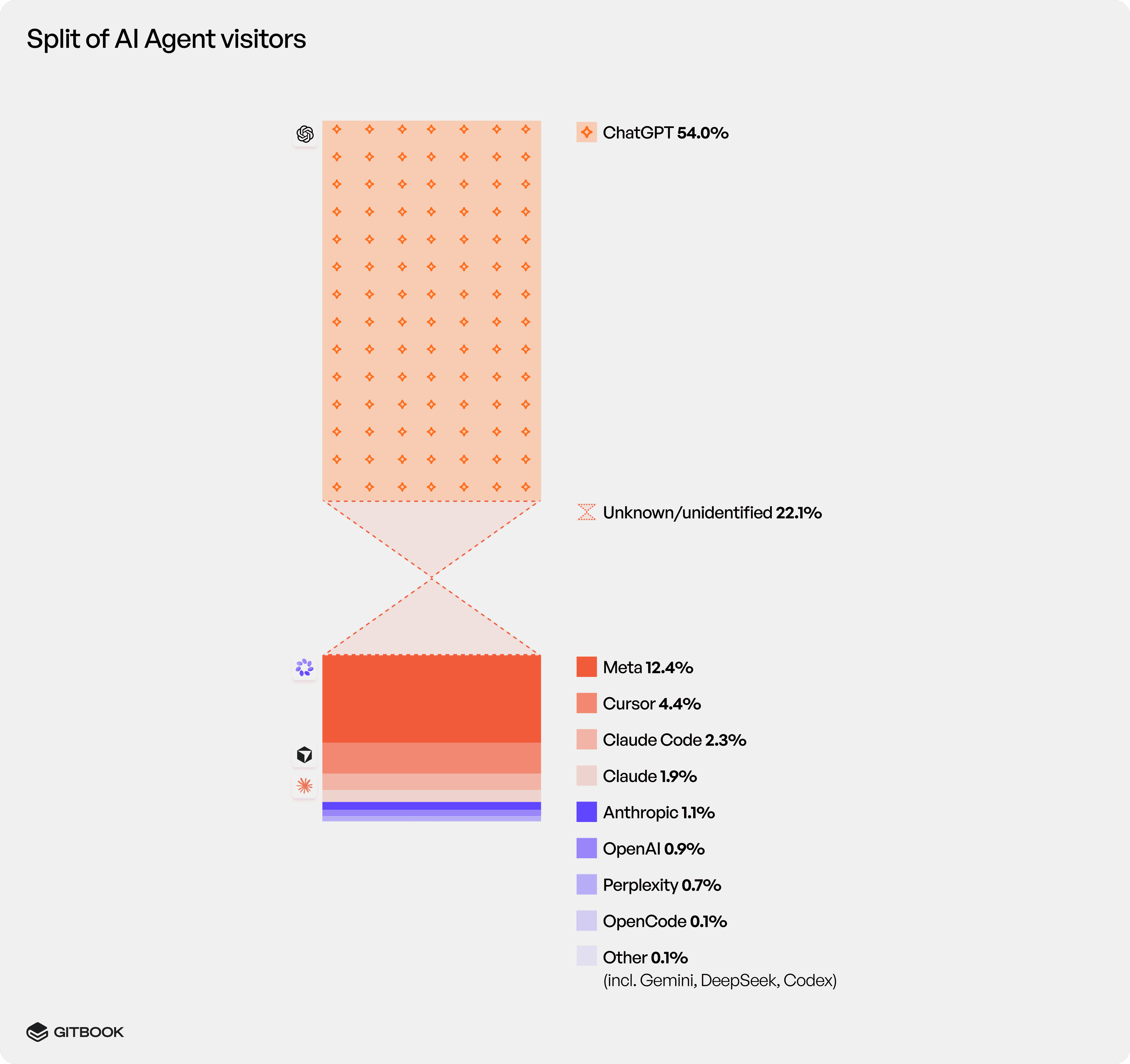
Coding agents — Cursor, Claude Code, OpenCode, VS Code, and Codex together — account for under 7% of agent traffic on GitBook.
Related research: Do AI coding agents actually read your docs?
And of course we cannot forget the 22% of agent traffic that doesn’t declare their source. We won’t speculate on what these tools are for now, but moving forward we are refining our data collection methods to identify these more clearly. For now, it makes it harder to draw concrete conclusions based on the data.
Regardless, the agent distribution we can see reflects who GitBook’s customers are and what they publish. GitBook hosts a wide range of documentation: product docs, internal knowledge bases, API references, help centers. AI assistants like ChatGPT and Meta AI are drawing on that full breadth — answering user questions across every category.
The implication is significant. When ChatGPT reads your docs, it’s not always for a developer running a coding tool. It’s likely an end user asking a question or a prospective customer exploring tooling, and your documentation is the source providing the answer — often invisibly, in the background. Your docs aren’t just a resource people visit. They’re becoming the underlying knowledge layer that AI products draw on to serve their users.
The trajectory
In January 2025, AI accounted for less than 10% of GitBook documentation traffic. By December 2025, that share had grown to roughly 41% — a 4x increase in a single year. Now, five months into 2026, AI agents alone account for the majority of intentional reads.
The pace of this change is as important as any individual data point: this trend hasn’t plateaued. Each time we look at the data, the line has moved further.
Docs are no longer read only by humans. Increasingly, they’re read for humans, by AI systems acting as intermediaries. That was true in February, but it’s more true now.
What this means for documentation teams
The practical conclusion from this data is the same one we drew in February, but it carries more weight with every passing month: documentation now serves two primary audiences, and they’re roughly equal in size.
That doesn’t mean writing for bots at the expense of humans. The qualities that make documentation easier for AI to parse — clear structure, consistent terminology, explicit context, well-defined relationships between concepts — are exactly the same qualities that make it better for human readers. That said, there are some things you can keep in mind to optimize your documentation for AI without breaking it for humans.
What it does mean is that documentation quality has a larger surface area than it used to. A poorly structured page doesn’t just frustrate a human reader. It produces a worse answer when ChatGPT uses it to respond to a user question. The stakes for getting docs right have quietly doubled.
GitBook is built for both audiences
Out of the box, every docs site published in GitBook includes a range of features designed to make documentation easier for AI systems to consume — without compromising the reading experience for humans:
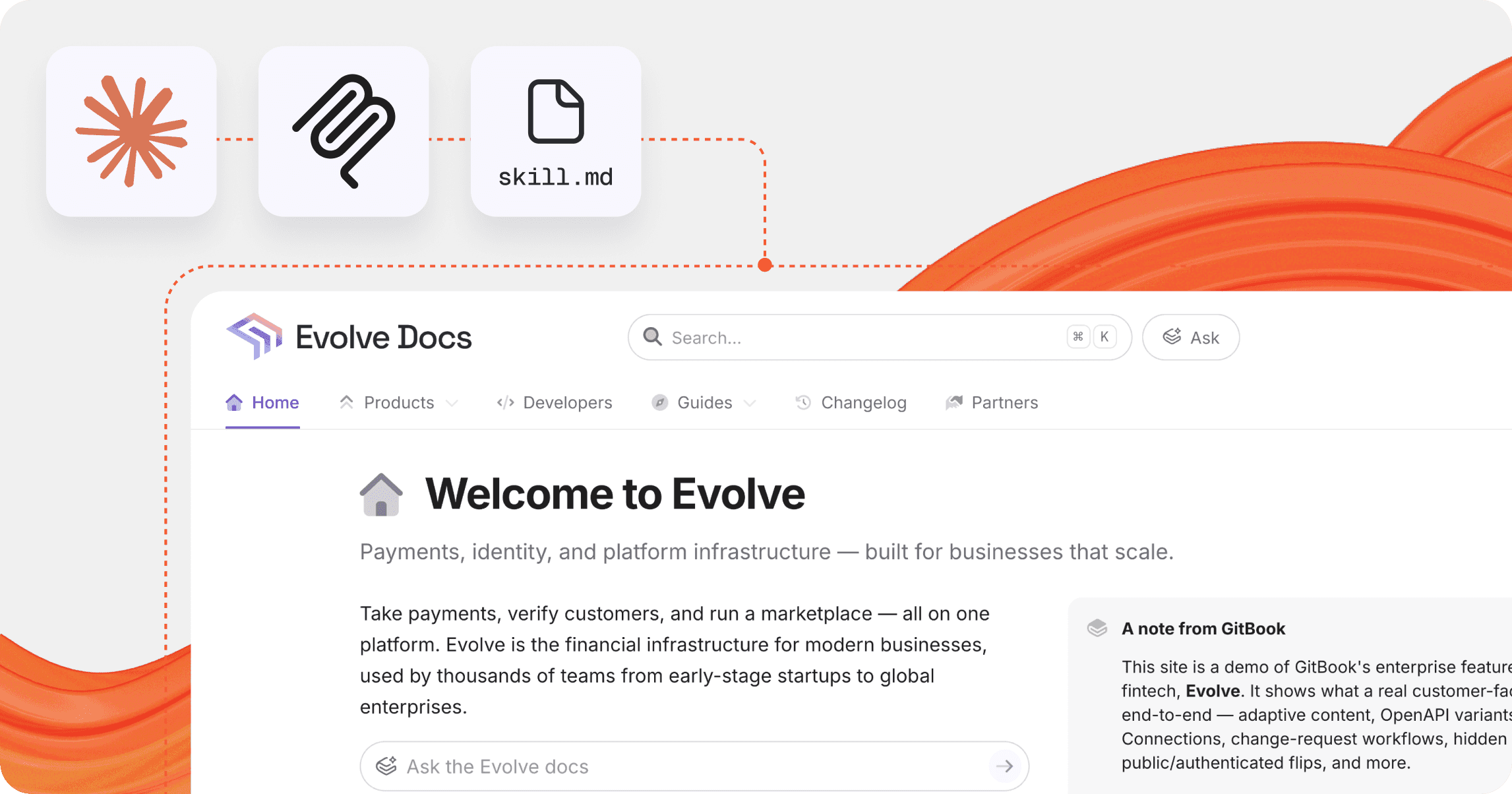
Native llms.txt and llms-full.txt support, giving AI systems a clear, standardized entry point to your docs
Markdown access for every page, enabling clean and predictable ingestion (add
.mdto any page URL)Automatic MCP server generation for every docs site, allowing AI agents to interact with documentation programmatically
Related: MCP explained: What is an MCP server and why does it matter for documentation?
These features have helped contribute to the AI readership growth we’ve observed. But the broader shift is happening regardless — AI systems are increasingly relying on high-quality documentation as a source of truth, and that reliance is only growing.
When more than half your readers are AI agents — and the number keeps rising — you need a documentation platform built for that reality. GitBook is designed to help you serve both audiences, without having to choose.
→ Get started with GitBook for free
→ Documentation: Learn more about GitBook’s AI optimizations
→ Article: How to optimize your documentation for AI (without breaking it for humans)
Share



Get the GitBook newsletter
Get the latest product news, useful resources and more in your inbox. 130k+ people read it every month.



Accurate docs. Better answers.
Your docs are already feeding AI. Are users getting the right answers or the wrong ones?
Accurate docs. Better answers.
Your docs are already feeding AI. Are users getting the right answers or the wrong ones?
Accurate docs. Better answers.
Your docs are already feeding AI. Are users getting the right answers or the wrong ones?
Product
Create & Publish
Solutions
Resources

© 2026 Copyright GitBook INC.
440 N Barranca Ave #7171, Covina, CA 91723, USA. EIN: 320502699
Get an AI summary




The State of Docs Report 2026
State of Docs brings together insights from documentation experts from across the industry
Product
Create & Publish
Solutions
Resources
© 2026 Copyright GitBook INC.
440 N Barranca Ave #7171, Covina, CA 91723, USA. EIN: 320502699
Get an AI summary
The State of Docs Report 2026
State of Docs brings together insights from documentation experts from across the industry

Product
Create & Publish
Solutions
Resources
© 2026 Copyright GitBook INC.
440 N Barranca Ave #7171, Covina, CA 91723, USA. EIN: 320502699
Get an AI summary
The State of Docs Report 2026
State of Docs brings together insights from documentation experts from across the industry